

Great hospitality will always depend on your team's ability to anticipate a guest’s needs. But as margins get tighter and skilled staff become harder to retain, you need to give them better tools.
Today, guests expect effortless, digitally enabled experiences from the moment they arrive. The right technology platform makes this possible, not by replacing people, but by freeing them up to deliver exceptional service.
It allows you to build operational consistency from site to site, make data-driven decisions that improve efficiency, and enhance security simply and effectively.
In this blog, we'll explore how proven and emerging technology in hospitality can help you deliver a better experience for your guests and a real return for your business.
The evolution of technology in hotels and restaurants
The role of technology in hospitality has shifted dramatically. Initially, its focus was often on back-office functions like those handled by Property Management Systems (PMS) for reservations and billing. Now, technology is a central pillar of the industry.
That shift happened in stages, but the net effect is simple. Technology moved from behind the desk to the center of the guest journey and experience.
Online booking changed how you booked rooms and tables. Mobile phones changed what guests expected when they arrived. Making it possible to check-in from their phone, keyless entry, the ability to order or request something without flagging down a staff member.

Each of those shifts added a new system, new integration, and new data stream. And most hospitality leaders added them one at a time, solving the immediate problem without addressing the underlying architecture.
Today, however, we operate in a much more richly connected digital landscape. The modern hotel or restaurant is no longer a patchwork of separate systems, but an integrated network of technologies.
Cloud-based property management systems that adapt as your business grows. Smart in-room technology that adjusts to each guest's preferences. The thread is clear. The pursuit of better guest experiences keeps pushing your industry to think bigger and move faster.
Along the way, all of that innovation has generated incredibly valuable data. And with it comes the power of advanced analytics.
How data analytics is revolutionizing hospitality operations
Hospitality has never been short on data. What's changed is the ability to use it well. Today's analytics tools can give you a much clearer picture on what's working and what isn't. It's not about replacing gut instinct. It's about supporting it with evidence.
By harnessing big data in hospitality, businesses gain a powerful competitive advantage.
Understand behavior through sensors and data analysis
Every interaction a guest has with a property generates data. By analyzing customer flow and queue lengths with people counting analytics, hospitality leaders can adjust staffing to reduce wait times and improve guest satisfaction.

This kind of data also shows which amenities are popular, when areas are busy, and how guests move around. These insights help improve layouts, services, and experiences to build loyalty.
Improve operational efficiency
In bustling kitchens, analytics can identify bottlenecks in order preparation, helping managers optimize station layouts and staffing.
For quick-service restaurants, tracking the entire drive-thru journey provides crucial data on service speed and order accuracy, which can be integrated with POS systems to ensure performance metrics are met.
Enhance visitor comfort with environmental sensors
Creating a pleasant environment is also a key part of operations. Environmental sensors can monitor indoor air quality, while the building’s systems can automatically adjust HVAC and lighting based on real-time occupancy.
This not only enhances guest comfort but also contributes to sustainability goals by reducing energy consumption.
3 ways analytics enhance safety and security
At a minimum, a hospitality venue should provide a safe and secure environment. Security has evolved from obvious deterrent cameras to intelligent, preventive systems that work seamlessly in the background.
High-definition cameras integrated with advanced analytics, network audio, smart access control, and supportive body worn solutions now operate in concert.
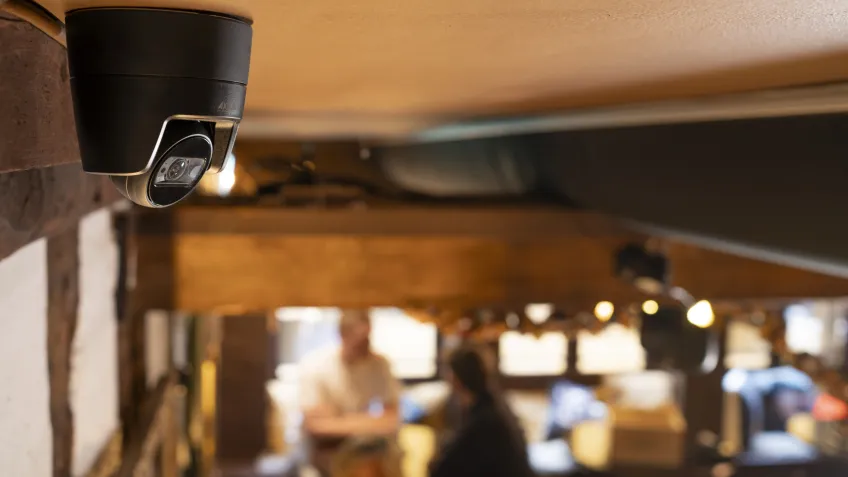
These systems proactively identify and help to de-escalate potential issues. They can detect specific events and trigger automatic responses, like audio alerts, to neutralize a situation immediately.
This integrated, discreet approach is crucial for building guest trust, protecting assets, and ultimately enhancing the well-being of both guests and staff.
Protecting guests and assets with modern systems
Today’s hotel and restaurant security systems go far beyond simple CCTV.
They provide crystal-clear video evidence, even in challenging low-light conditions, and when integrated with intelligent analytics, they become proactive tools.
These systems can automatically detect unusual activity, such as loitering in restricted areas or detect specific sounds like glass breaking, and send real-time alerts to staff, allowing for swift intervention before an incident escalates.
Secure access with smart locks and mobile credentials
The days of easily duplicated metal keys are numbered. Smart locks and mobile access control, often utilizing RFID cards or guest smartphones, provide a more secure and convenient method of access control.
This technology creates a detailed audit trail, logging every entry into a room, which is invaluable for investigating disputes or incidents.
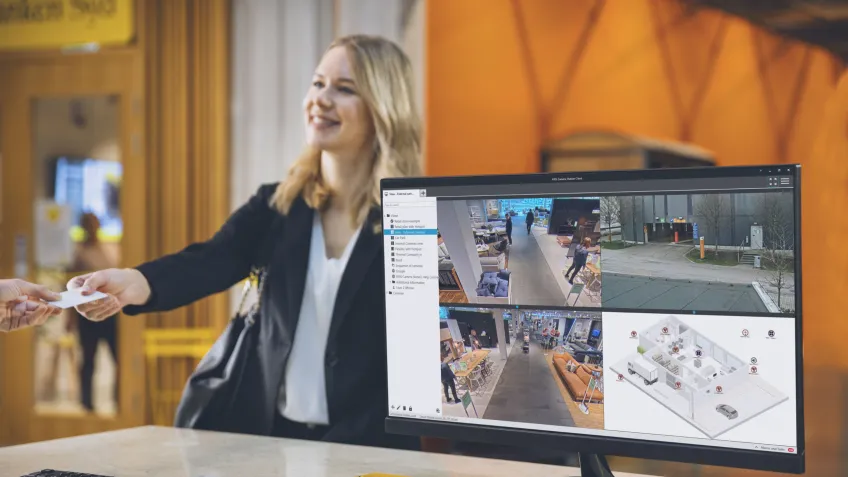
The rise of mobile check-in with mobile credentials also enhances security by reducing the risk of lost or stolen keycards and provides a seamless, convenient experience for guests.
Ensure data privacy with secure network infrastructure
As properties become more connected, cybersecurity in hospitality becomes paramount.
Hotels and restaurants handle a vast amount of sensitive information, from guest credit card details to personal identification. A breach can be catastrophic for an organization's reputation.
3 key ways to effectively manage multiple sites
For hospitality brands with multiple properties, ensuring consistent operational and security standards across the entire portfolio can be a complex challenge.
Access information anywhere with remote access
Centralized surveillance systems, particularly a cloud-based video management system (VMS), offer a powerful solution by allowing a single team to monitor and manage all locations.
This is particularly beneficial when you have multiple sites that require management. Remote access allows you to access, monitor, and manage, all from a central or remote command center.
Achieve operational consistency and efficiency
As described in our article on multi-site surveillance, this model dramatically increases efficiency. It simplifies operations and standardizes security protocols across all properties, whether you have five or five hundred.
Support business growth by ensuring scalability
As a hospitality group grows, its technology must grow with it. Modern multi-site systems are designed for scalability.
Adding a new hotel or restaurant to the central management platform is a straightforward process.
As detailed in our white paper on multi-site systems, this ensures that security and operational oversight can expand seamlessly alongside the business, providing long-term value and future-proofing the initial technology investment.
The future of Hospitality: What to expect next
The future of technology in hospitality lies in creating truly intelligent environments where systems are not just connected, but predictive and responsive.
Emerging technology like advanced AI will analyze data in real-time to hyper-personalize the guest experience. This could range from automatically adjusting room lighting to a guest's known preference to proactively offering personalized dining recommendations.
We can also expect biometric access control to streamline identity verification and robotics to handle routine tasks, freeing human staff to focus on higher-value guest interactions.
The hospitality of the future will be defined by this seamless blend of efficiency, personalization, and invisible security.
